


How Do Hearing Aids Work: Types, Features & Limitations
The hearing aid is an electronic device. What it does can be reduced to three main functions – first, a microphone receives sounds; second, a microchip processes the received sound in accordance with your particular hearing problems, and third, a receiver emits the processed sound to your ear. Modern devices use digital processing, include Bluetooth to function as wireless earbuds, and use artificial intelligence to adapt to the ambient environment on their own. Below, each of those ideas gets its own plain-language section — including how they work and what they can't do
How do hearing aids work?
Picture a tiny sound crew living behind your ear. Three members do all the work:
- The microphone is the "ear" that picks up the world and turns it into an electrical signal.
- The chip (amplifier/processor) is the sound engineer. It takes that signal and boosts the frequencies you can't hear well, while leaving the ones you can alone.
- The receiver (speaker) is the "voice" that pushes the finished sound into your ear canal.
That's the whole machine. Everything else in this article — digital, Bluetooth, AI, the different shapes — is a variation on or an addition to those three parts. The U.S. National Institute on Deafness and Other Communication Disorders describes aids this way — microphone, amplifier, and speaker, fitted to your audiogram.
How do digital hearing aids work?
"Digital" is the foundation everything else builds on, so it's worth a clear explanation. An older analog aid was dumb: it grabbed all sound and made it louder, period. A digital aid is different because the chip first turns the sound into numbers — the same way a phone records music — and then reshapes those numbers. Concretely, the chip does jobs like these (these are the standard digital tools audiology references):
- Compression — quietly makes soft sounds audible and keeps loud sounds from blasting your ear (wide dynamic range compression).
- Directionality — uses two microphones to favor the person in front of you over noise behind you.
- Noise reduction — trims steady background hiss (like a fan or traffic).
- Feedback management — kills the whistle before it starts.
- Frequency lowering — shifts sounds you can't hear (very high pitches) down to a range you can.
The key idea: digital doesn't just mean "modern" — it means the aid is programmed per frequency to your audiogram. That's why two people with the same model can hear completely differently. Bluetooth and AI are features layered on top of this digital base.
How do Bluetooth hearing aids work?
Quick clarification that prevents confusion: Bluetooth is a feature, not a different kind of amplification. A Bluetooth aid is still the three-part digital device above — it just adds a short-range wireless radio.
What that radio lets it do:
- Stream audio from your phone, TV, or computer straight into the aids, so they work like wireless earbuds that also help you hear.
- App control — adjust volume or bass/treble from your phone instead of fiddling with a tiny button.
- Hands-free calls — take a phone call with sound in both ears.
For anyone who struggles to hear the TV or talk on the phone, Bluetooth is often the single most useful feature. One honest note: streaming uses more battery, so Bluetooth users lean on rechargeable models or carry spare cells.
How do AI-powered hearing aids work?
"AI hearing aids" and "AI-powered hearing aids" are the same thing — just two ways people search for it. Here's what the "AI" actually is, without the hype. An AI aid uses the same digital system from above (microphone, chip, receiver) — but the chip is trained with machine learning to make decisions on its own. Instead of you or your audiologist picking a "restaurant" or "quiet room" program, the AI:
- Listens to the scene — classifies what it's hearing (is that speech? wind? a crowded room?).
- Auto-applies the digital tools we just covered — turning down background noise, pointing the microphones forward, compressing the clatter — without you touching anything.
- Learns your habits — some models remember that you always turn it up at the dinner table and start doing it for you.
The honest take: "AI" is mostly a smarter, self-adjusting version of the digital processing above. It is not a tiny computer that understands language like a person; it's pattern recognition that reacts faster and more precisely than manual settings. A few premium models bolt on separate sensors (fall detection, step counting) — but those are extras, not what makes you hear better. The hearing part is still microphone → chip → receiver. (The underlying digital functions AI automates are documented in standard audiology references; individual "AI" features vary by manufacturer.)
The main types, by where they sit
Below is a list of different hearing aid styles all of which make use of the air conduction pathway as well as digital or artificial intelligence-based electronics described above. They vary in terms of their size, power and discreetness.
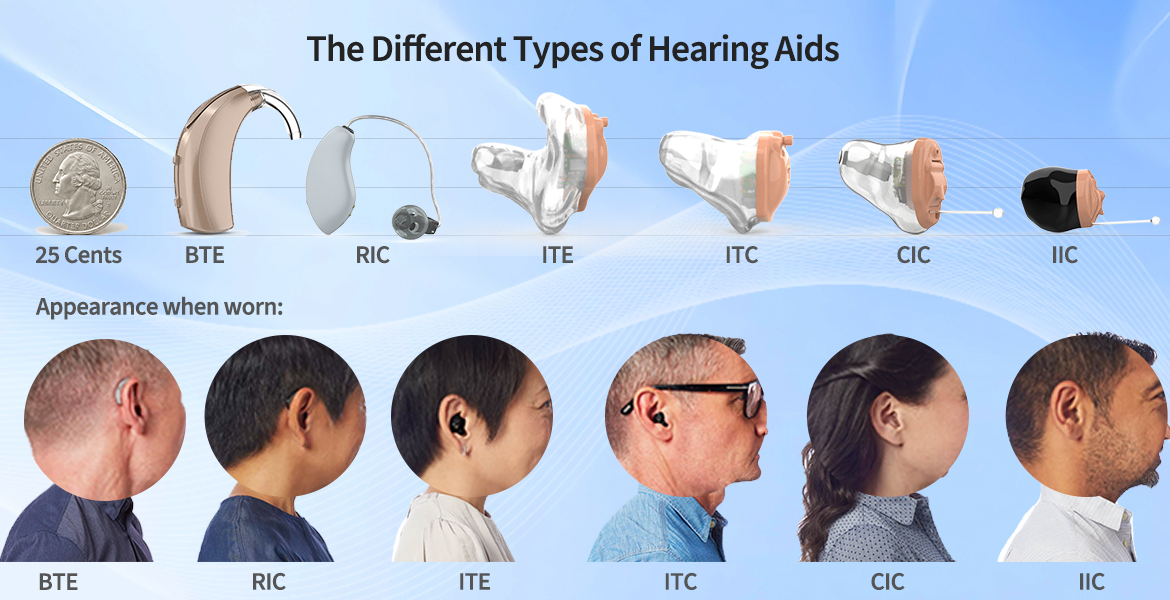
- Behind-the-ear (BTE): the housing component rests behind the ear, and the sound is fed into the ear via a tube or wire. Most powerful and easy to handle, this style is used for moderately severe losses and children. Shortcoming: most conspicuous.
- In-the-ear / in-the-canal (ITE / ITC / CIC): this style is custom-made to fit the ear canal, making it the most discreet option. Shortcoming: small battery size and less power – this style is suitable for mild to moderate hearing loss.
- Receiver-in-canal (RIC / RITE): the receiver is placed in the ear canal using a very thin wire while the processor remains behind the ear.
|
Style |
Most discreet? |
Most power? |
Best for |
Trade-off |
|
BTE |
No |
Yes |
Moderate–severe, kids |
Most visible |
|
ITE / ITC / CIC |
Yes |
Limited |
Mild–moderate, appearance matters |
Smaller battery |
|
RIC / RITE |
Moderate |
Good |
Most mild–severe |
Small parts, more care |
In-ear or behind-ear — which is better? Significant loss or max battery life → behind-the-ear. Appearance tops your list, and loss is mild–moderate → in-ear. Your audiogram decides what's actually appropriate.
Bone conduction hearing aids — a completely different principle
This one breaks the "sound goes in your ear" rule. Instead of sending sound through the ear canal, a bone conduction device rests against the bone behind your ear and sends vibrations through your skull directly to the inner ear (cochlea) — bypassing the outer and middle ear.
Why skip the canal? Some hearing loss lives in the outer or middle ear, where a normal aid can't get sound through. Bone conduction helps when:
- there's a conductive or mixed loss (inner ear works, but sound can't reach it normally);
- the ear canal can't be used — microtia/atresia (canal didn't form), chronic infections, severe allergies;
- there's single-sided deafness (SSD) — it picks up sound on the deaf side and routes the vibration through the skull to the good ear.
Two forms: implantable (titanium fixture placed in bone during surgery) and non-implantable (worn on a softband or attached to glasses). Both are usually fitted by an ENT or audiology team, so unlike the styles above, bone conduction is typically not an OTC self-select product.
Honest boundary: brilliant for the right loss type, useless for the wrong one. If the inner ear or hearing nerve is the problem (sensorineural loss), vibrating the skull won't help much. And in SSD it doesn't "restore" the dead ear — it uses your good ear to hear the bad side. (Sources: NHS audiology patient-information leaflets describe this mechanism and these indications.)
Tinnitus hearing aids — how they quiet the ringing
Tinnitus is hearing a sound — ringing, buzzing, roaring — that has no external source, so no one else hears it. It's common: surveys estimate 10 to 25% of adults experience it.
A hearing aid can help tinnitus two ways:
- By amplifying the world — louder, clearer real sound makes the ringing less noticeable by contrast.
- By incorporating sound therapy, which involves many modern hearing aids that feature tinnitus therapy programs playing low-level white or pink noises, or even carving out a notch in the sound frequency at which your tinnitus occurs (notch therapy).
The truth of the matter is that hearing aids, along with sound therapy devices, treat tinnitus, but do not cure it. Should you have perfect hearing, apart from tinnitus, then maybe a device made specifically to cover up tinnitus would be more appropriate for you. NIDCD describes tinnitus as a sound with no external source affecting 10–25% of adults, and sound therapy as masking/distraction/habituation.
Do hearing aids work for everyone?
- Mild to moderate — often a good fit, and in the U.S. this is exactly the band over-the-counter (OTC) aids are approved for: adults with perceived mild-to-moderate loss can buy them directly, no exam required.
- Moderate to severe — usually better served by a prescription aid fitted by a professional who can push more power and tune precisely.
- Profound loss or total deafness — especially if the hearing nerve is damaged, aids have limited value and a cochlear implant may be the real answer.
See a doctor first if: loss started suddenly in one ear, comes with vertigo, or includes ear pain or discharge. Those are red flags needing a medical work-up, not a self-purchase. (OTC boundary per NIDCD; the FDA created the OTC category in 2022.)
The drawbacks of hearing aids
Every type above shares these honest drawbacks — no manufacturer page lists them all in one place:
- Feedback / whistling when the aid is loose or your hand cups it.
- Occlusion — your own voice can sound boomy because the ear is blocked.
- An adjustment period — most people need a few weeks to a couple of months to adapt, not instant relief.
- Daily maintenance — cleaning, drying, battery or charging upkeep.
- Cost — aids are an investment and don't last forever.
None mean they "don't work." They mean realistic expectations beat marketing.
OTC vs. prescription: what you can buy without a doctor
In the U.S., the FDA created a distinct over-the-counter category (finalized 2022). Per the NIH, OTC aids are for adults with perceived mild-to-moderate loss and can be bought directly, no hearing exam required. Prescription aids remain the route for more complex or severe needs, with a professional's fitting and follow-up. If you fit the "mild-to-moderate, mostly want the TV and conversations clearer" description, OTC is a reasonable start. If any red-flag sign applies, see a clinician first.
The first week: the "5-minute rule" and getting used to it
People often search for a "5-minute rule" for hearing aids. There isn't an official clinical rule by that exact name, but it reflects a common recommendation from hearing professionals: start slowly and build up gradually.
Why they can feel strange at first
If you have been dealing with hearing loss for some time now, your brain would have adapted to the hearing loss and is accustomed to not hearing many things. Wearing hearing aids means that you will start hearing speech very clearly, but you will also start hearing the background noise that your brain would have been accustomed to filtering out. Water running, papers rustling, the air conditioner, crockery sounds, and even your footsteps could be much louder than usual. But that doesn’t mean that the hearing aids are not properly fitted.
Give yourself time to adjust
It's important to wear aids in quiet environments for shorter times and build up the time and volume of use gradually. This could mean an hour or two in quiet surroundings at home in the first few days, half-days in the second week, and gradually more time in subsequent weeks depending on comfort. Everyone is different, but the goal should be comfortable all-day wear and not clear hearing from the start. You may notice your own voice sounds different initially, as does background noise. However, these issues tend to get easier with continued use. However, pain, whistling, and aids falling out indicate there is something more serious happening.
Consistency is more important than endurance
Putting on the aids regularly throughout the day is generally more productive than struggling through an exhausting one-session marathon. In case you are working with someone else, then this point holds true as well. Wear them for a few minutes every day, rather than several hours on a single day and none the next. The most important thing is not to make an initial judgment about the first few days of wearing them. Your brain needs some time to adjust to them before deciding whether or not they work for you.
FAQ
Can a hearing aid help with tinnitus?
Often yes: by amplifying real sound so the ringing is less noticeable, and by adding a sound-therapy program (masking or notch therapy). They manage tinnitus; they don't cure it.
What are the disadvantages of a hearing aid?
Possible whistling/feedback, a "full" feeling in the ear, a weeks-long adjustment period, daily cleaning and battery upkeep, and cost. None mean failure — they mean set realistic expectations.
What is the 5-minute rule for hearing aids?
Shorthand for the standard ease-in advice: start with short wearing sessions in quiet, then gradually increase time and background noise over weeks.
Can you hear fully with hearing aids?
No. They make sound audible to your brain but don't repair the ear, so clarity — especially in noise — may stay short of normal, particularly with sensorineural loss.
Do AirPods work as hearing aids?
Regular AirPods are consumer audio devices, not medical devices, and aren't a substitute for a hearing aid or hearing test. Some phones offer a "conversation boost" feature, but for actual hearing loss a proper (or OTC) aid is the safer, more capable choice.
Next steps
Now, if this guide assisted you in comprehending the various types of hearing aids and their target audience, the next step would be to shortlist the devices according to your hearing requirements, as well as your lifestyle and budget.
For a detailed shopping guideline, go through Hearing Aid 101: The Complete Beginner's Guide, where you will learn about the factors that should be taken into consideration prior to purchasing one. Post-purchase, you can refer to How to Adapt to Your Hearing Aid to know what you should expect during your first few weeks.
In case you fall under the category of people who experience any of the red-flag signs stated above, make sure that you have your hearing tested before buying a hearing aid. If this guide helped you understand the different types of hearing aids and who they're designed for, the next step is narrowing your options based on your hearing needs, lifestyle, and budget.
Sources
- National Institute on Deafness and Other Communication Disorders (NIDCD), U.S. National Institutes of Health — Hearing Aids: Styles/Types & How They Work (microphone–amplifier–receiver path; OTC category for adult perceived mild-to-moderate loss).
- NIDCD, NIH — Tinnitus: Causes and Treatment (definition as a sound with no external source; 10–25% of adults; sound therapy as masking/distraction/habituation).
- Wikipedia — Hearing aid (technology section; standard digital signal-processing functions: feedback management, wide dynamic range compression, directionality, frequency lowering, noise reduction; programming by frequency to the audiogram).
- NHS audiology patient-information leaflets (Alder Hey; South Tees; The Rotherham NHS Foundation Trust) — Bone Conduction Hearing Devices (skull-vibration transmission to the cochlea; indications and implantable vs. non-implantable forms).
- Manufacturer documentation (e.g., Starkey "artificial intelligence" product pages) — descriptions of on-device machine-learning scene classification and self-adjusting processing; individual AI features vary by brand and should be checked against the spec sheet.
-
U.S. Food and Drug Administration (FDA) — Over-the-Counter Hearing Aids regulatory information (OTC category established 2022).